
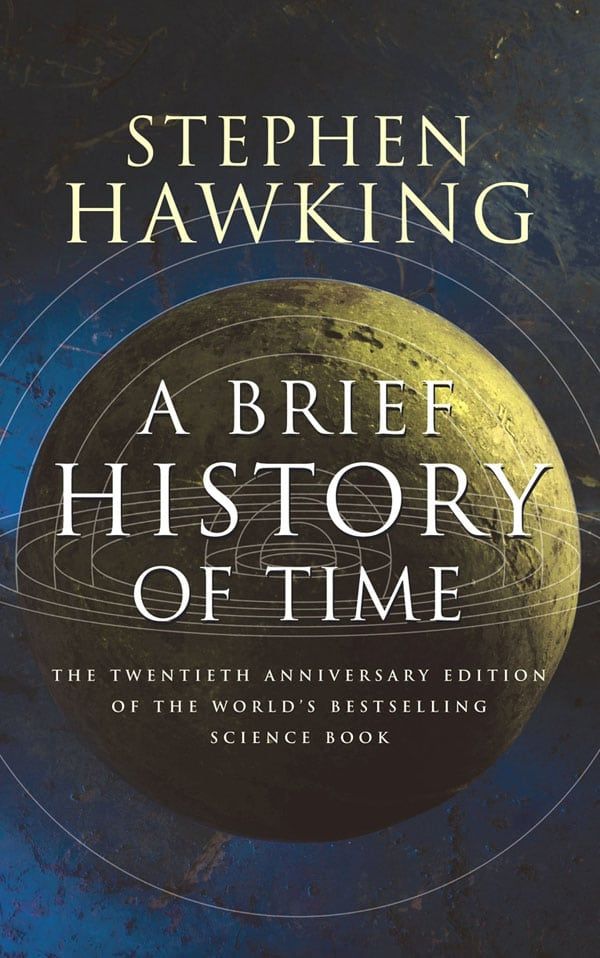

A Brief History of Time is one of the most celebrated science books ever written, having sold over 25 million copies since its publication in 1988. Stephen Hawking set out to write a book about the biggest questions in physics — the nature of time, the origin of the universe, the existence of black holes — that could be understood by readers with no scientific background whatsoever.
The book begins with a history of our understanding of the universe, from Aristotle’s view of a stationary Earth at the center of the cosmos to Galileo’s revolutionary astronomical observations to Newton’s laws of motion and gravity. Hawking then guides readers through the revolutionary theories of the twentieth century, including Einstein’s special and general theories of relativity and the development of quantum mechanics.
Hawking’s own major contributions — particularly his work on black holes and the discovery that they are not entirely black but emit radiation now known as Hawking radiation — are explained in accessible terms that make the wonder and significance of these discoveries palpable even to lay readers. He also explores the possibility of a unified theory of physics that would reconcile general relativity with quantum mechanics.
The book concludes with a philosophical reflection on what it would mean if we discovered a complete theory of the universe and what that would tell us about the mind of God. A Brief History of Time sparked a worldwide resurgence of popular interest in physics and established Hawking as the foremost communicator of science to general audiences.
Be the first to review “A Brief History of Time by Stephen Hawking”
Related products
Science & Technology
A definitive biography of John von Neumann, the twentieth century's most important mathematician, whose ideas shaped computers, game theory, quantum mechanics, and nuclear weapons.
Science & Technology
Richard Dawkins' revolutionary reframing of evolutionary theory that places the gene rather than the individual at the center of natural selection, introducing the concept of the meme.
Science & Technology
Neil deGrasse Tyson distills the essential concepts of astrophysics into a compact, witty, and accessible guide for curious readers who want cosmic perspective without the physics degree.

Science & Technology
Nobel Prize-winning physicist Richard Feynman's irresistibly entertaining memoir of a life lived with insatiable curiosity, irreverence for authority, and delight in figuring out how things work.

Science & Technology
Walter Isaacson tells the story of the digital revolution and the brilliant, collaborative teams that created the computer, the internet, and the world of modern technology.
Science & Technology
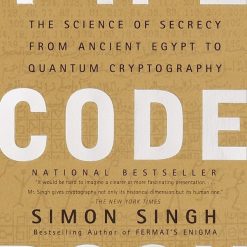
Simon Singh's gripping history of cryptography from ancient Caesar ciphers to modern public-key encryption, told through the greatest code-breaking battles in history.

Science & Technology
NASA astronaut Mark Watney is stranded alone on Mars and must use science, ingenuity, and a dark sense of humor to survive until a rescue mission can reach him.
Science & Technology
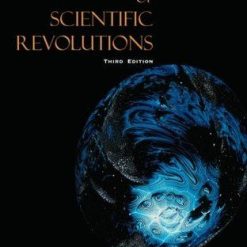
Thomas Kuhn's landmark work on how science progresses through revolutionary paradigm shifts, introducing concepts that permanently changed our understanding of scientific development.
Reviews
There are no reviews yet.